For more than 35 years, the Central Alabama Community Foundation (CACF) has been a trusted partner in strengthening communities across the River Region, the Wiregrass, and East Alabama. Established in 1987 by civic leaders with a vision to create a permanent charitable foundation, CACF now manages more than $100 million in charitable assets and has distributed over $75 million to organizations serving local needs.
Through the generosity of individual and corporate donors, CACF awards over $6 million each year in grants and scholarships that address critical community priorities. With more than 230 charitable funds, the Foundation supports initiatives in education, health, human services, cultural arts, recreation, historic preservation, and other civic concerns—all designed to create a better quality of life for those who live and work in Central Alabama.
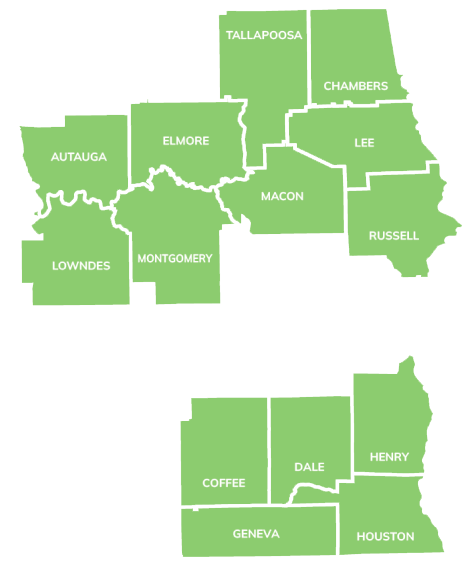
CACF’s reach extends across Autauga, Chambers, Coffee, Dale, Elmore, Geneva, Henry, Houston, Lee, Lowndes, Macon, Montgomery, Russell, and Tallapoosa counties. To further serve local communities, CACF is joined by affiliate foundations that expand and deepen our impact:
Together with these affiliates, CACF connects generosity with opportunity, and helps donors invest in their passions, strengthen nonprofits, and make a lasting difference for generations to come.
A community foundation is a collection of individual funds and resources given by local citizens to enhance and support the quality of life in their community. It is a tax-exempt public charity that allows many individuals, through gifts and bequests, to establish permanent endowment funds under the umbrella of one large foundation. Money generated by these funds is distributed to the local community in the form of grants to other nonprofit organizations and agencies to address needs and opportunities.
CACF was founded in 1987 to provide simple, flexible, and effective ways for permanent endowment funds to be established and managed. The foundation works with donors to help achieve their personal, financial and philanthropic goals and to establish endowments for a variety of purposes. CACF is completely autonomous and all decisions are made locally.
CACF is one of the over 650 community foundations nationwide. CACF is a member of the Council on Foundations, an association that represents all types of charitable giving programs. Community Foundations are the fastest growing vehicle for giving in the United States.

The foundation’s funds come from individuals and businesses who recognize the need for a permanent base of charitable capital to support nonprofit activities. Endowments are built by pooling contributions from many donors.
Community foundations offer a variety of options for making donations. By combining your resources with those of others who share your interests, you can maximize the impact of modest contributions with minimal costs. The Foundation also welcomes honorariums and memorial gifts.
Yes. CACF is recognized as a 501(c)3 organization by the Internal Revenue Service.
A diversified investment portfolio is managed by Edward Jones, Jackson Thornton Asset Management, Merrill Lynch Private Wealth Management, and CapTrust. Investment guidelines emphasize the protection of the corpus with the generation of income. The investment committee seeks total return with minimum risk over the long term. Members review investment performance quarterly and the foundation’s staff oversees the distribution of income to more than 200 nonprofit entities located predominantly in central Alabama.
To date, more than $75 million has been given to nonprofit organizations and individuals. In addition, the Foundation administers scholarship funds that benefit students in Autauga, Chambers, Coffee, Dale, Elmore, Geneva, Henry, Houston, Lee, Lowndes, Macon, Montgomery, Russell, and Tallapoosa.
The foundation uses an application portal, which can be accessed through the Grants section of our website.
Both are important resources to the community. Both are necessary and compatible. Some have described the differences by suggesting the United Way is more like a community checkbook (raising and distributing money annually), while a community foundation is more like a savings account (distributing interest from long-term funds in perpetuity). An additional difference is the foundation’s broad scope of funding (including arts, religion and scholarships; not just health and human services) and its greater base of grantees.